

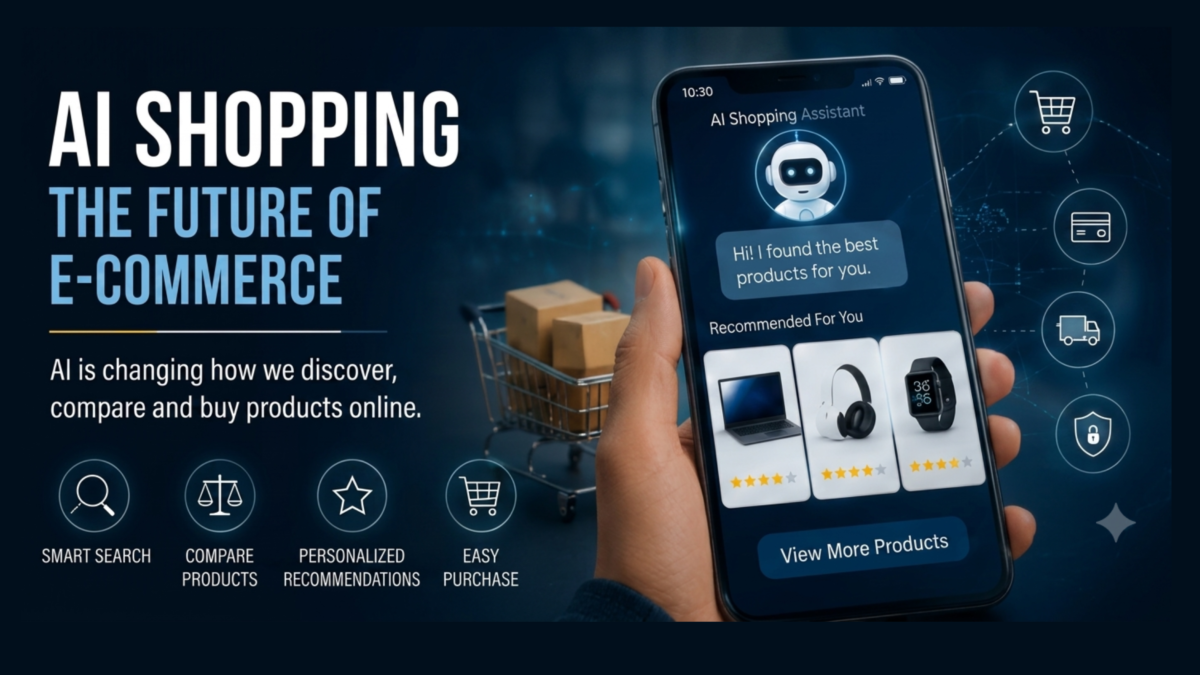
AI is changing how people discover, compare, and buy products. As consumers increasingly turn to AI for shopping decisions, brands and retailers face a new question: how do you win when AI becomes the gateway to the customer?
For years, online shopping followed a familiar path. Consumers searched on Google, visited multiple websites, read product reviews, compared prices and features, and then decided what to buy. Now, artificial intelligence is beginning to change that journey.
Instead of searching through dozens of websites, consumers can ask an AI assistant questions such as:
“What is the best laptop for me?”
“Which smartphone offers the best value for my budget?”
“Compare these two products and tell me which one is better.”
AI can increasingly help consumers find products, compare options, evaluate prices and narrow down their choices. This emerging shift is known as AI shopping or AI-powered commerce.
AI Is Changing the Shopping Journey
AI is no longer limited to chatbots, content creation or productivity tools. It is becoming part of the consumer shopping journey.
NIQ’s 2026 research found that 42% of consumers in the United States had used at least one AI tool for shopping within the previous month. The research also found that 17% had used AI for product recommendations, 10% had interacted with an AI-powered shopping assistant and 5% had used fully autonomous AI agents to place orders on their behalf.
The numbers suggest that fully autonomous shopping is still at an early stage. But AI-assisted decision-making is already becoming a meaningful part of online shopping.
The traditional shopping journey looks like this: Search → Compare → Decide → Buy
AI shopping could increasingly make it: Ask AI → Get Recommendations → Compare → Buy
The difference may look simple, but it could reshape the entire e-commerce industry.
From Search to AI Recommendations
For decades, search engines have played a central role in online commerce.
A consumer searches for a product, and businesses compete to appear near the top of the results.
But AI introduces a different model.
Instead of showing hundreds of links, an AI shopping assistant can potentially understand what a consumer wants and provide a smaller selection of relevant products.
For example, someone looking for a laptop could tell an AI assistant their budget, preferred operating system, intended use and other requirements.
The AI could then compare available products and recommend a shortlist.
This means the competition may gradually move from:
“Who ranks highest in search?”
to:
“Which product gets recommended by AI?”
That could become one of the most important changes in the future of e-commerce.
The Rise of AI Shopping Agents
The next stage is even more significant.
AI shopping agents are being developed to move beyond recommendations and perform tasks on behalf of consumers.
Harvard Business Review reports that AI agents are increasingly being used to research, compare and purchase products, while companies across the technology and retail ecosystem are building systems that allow AI agents to interact with merchants and complete transactions.
This creates a new possibility for e-commerce: A consumer may no longer need to visit multiple online stores, compare every option manually or complete every step themselves.
Instead, they could simply describe what they need. The AI agent could potentially search, compare, recommend and eventually purchase. That is the basic idea behind agentic commerce.
What Does AI Shopping Mean for Brands?
The rise of AI shopping could force brands to rethink digital visibility.
In traditional e-commerce, brands invest heavily in search engine optimization, advertising, social media and marketplace rankings.
But if consumers increasingly discover products through AI assistants, another form of visibility could become important:
AI visibility.
AI systems need accurate information to understand products and brands.
That makes product descriptions, specifications, prices, availability, reviews and other structured information increasingly important.
A brand may therefore need to think beyond traditional SEO.
The new question could be:
“Can AI understand, trust and recommend our product?”
This does not mean traditional SEO is disappearing.
Instead, AI shopping could create another layer of digital competition alongside search engines, marketplaces and social media.
Retailers Could Gain a New Opportunity
AI shopping could also create opportunities for retailers.
Retailers can use AI to personalize recommendations, understand customer preferences and reduce the time consumers spend searching for products.
Imagine a customer looking at 30 similar products.
Instead of browsing every option, an AI assistant could identify a few products that match the customer’s budget and requirements.
That could make the shopping experience faster and more convenient.
For retailers, the potential benefit is equally important: reducing friction between product discovery and purchase.
Advertising Could Change Too
The rise of AI shopping could also affect the digital advertising industry.
Today, brands compete for attention across search engines, social platforms, marketplaces and other digital channels.
But if AI becomes an important product discovery layer, brands may increasingly compete for visibility inside AI-generated recommendations.
That raises new questions:
How does a brand become visible to an AI?
How does an AI decide which product to recommend?
Can consumers trust AI-generated recommendations?
These questions could influence the future of advertising, affiliate commerce, sponsored recommendations and retail media.
Trust Could Become the Biggest Issue
AI shopping also comes with significant challenges.
AI systems can make mistakes, misunderstand product information or provide outdated recommendations.
Consumers may also question whether an AI recommendation is based purely on product suitability or influenced by commercial incentives.
Data privacy is another major concern.
The more personalized AI shopping becomes, the more information an AI system may need about a consumer’s preferences, budget, purchase history and behavior.
That creates a difficult balance between personalization, convenience and privacy.
NIQ’s research also highlights the growing importance of accuracy, transparency and data responsibility as AI becomes more involved in consumer decision-making.
What Does AI Shopping Mean for Small Businesses?
AI shopping could have an interesting impact on small businesses.
In traditional e-commerce, smaller brands often struggle to compete with large companies that have bigger advertising budgets and stronger marketplace visibility.
AI could potentially create a different playing field.
If a small business provides accurate product information, competitive pricing, reliable customer reviews and a strong product offering, its products could potentially become part of an AI-generated recommendation.
But there is an important condition:
AI must be able to find and understand the business.
That makes high-quality digital product information increasingly valuable.
What Could AI Shopping Mean for Bangladesh?
Bangladesh’s e-commerce market is also evolving, with online marketplaces, social commerce and thousands of small businesses competing for consumers’ attention.
As AI shopping becomes more mainstream globally, Bangladeshi businesses may also need to prepare for a new form of digital discovery.
Businesses that clearly present their products online—with accurate descriptions, prices, specifications, availability and customer reviews—could be better positioned for an AI-driven shopping environment.
For local brands, the opportunity is particularly interesting.
A small Bangladeshi business may not have the advertising budget of a global company. But if its products are relevant, competitively priced and well represented online, AI-powered discovery could potentially create new paths to customers.
The Bigger Picture
The biggest change brought by AI shopping may not be the disappearance of online stores.
It could be the transformation of how consumers make decisions.
For years, search engines helped consumers find information.
Marketplaces helped them find products.
Social media helped brands capture attention.
AI could increasingly connect all three stages by helping consumers understand what they need, compare available options and decide what to buy.
The result could be a new e-commerce model where the most important competition is not simply for a search ranking or an advertisement.
It is for a place in the AI recommendation.
Today, consumers ask AI questions.
Tomorrow, they may increasingly ask:
“Find the best product for me.”
And when that happens, the future of e-commerce may depend not only on who sells the best product—but on which products AI chooses to recommend.
BTimes Analysis | Trends
Sources: NielsenIQ (NIQ), Harvard Business Review