

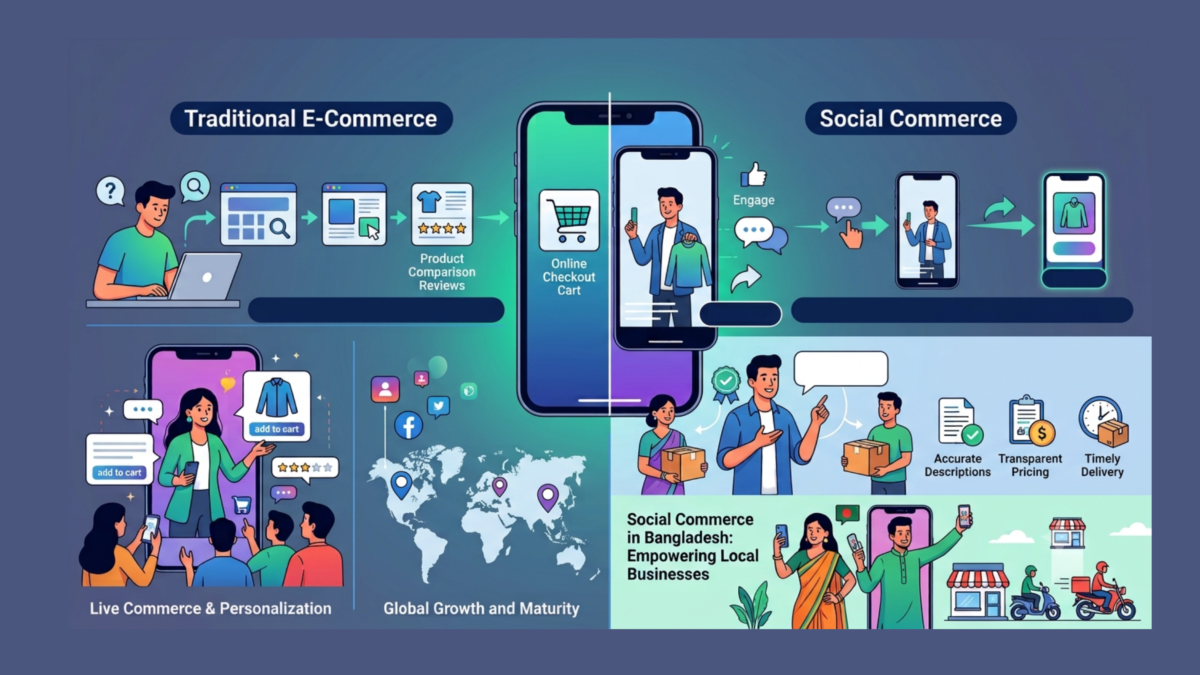
Social media is no longer just a place to connect, consume content, or discover brands. It is increasingly becoming a place where consumers discover, evaluate, and buy products—reshaping online shopping and the future of e-commerce.
For years, online shopping followed a familiar path. Consumers searched for a product, visited different websites, compared prices and features, read reviews, and then made a purchase decision.
Social commerce is changing that journey. A consumer may now discover a product while watching a short video, see how it works, read comments and reviews, and complete a purchase without leaving the social platform.
The journey is becoming: Discover → Engage → Evaluate → Buy
This shift is known as social commerce.
From Product Discovery to Purchase
According to NIQ’s 2026 global commerce research, around 59% of consumers in Asia-Pacific purchase through social commerce. Western markets are less mature, but social commerce is growing there as well, with roughly one-third of consumers in North America and Europe purchasing products through social platforms.
This means social media is moving beyond advertising.
It is becoming an important part of the entire online shopping journey—from product discovery and consideration to purchase.
NIQ’s 2026 research also found that social commerce growth in the United States is outpacing traditional e-commerce, with social commerce growth reported at 62.9%.
Why Social Media Matters to E-Commerce
One of the biggest advantages of social commerce is content.
Traditional advertising tells consumers about a product. A short-form video can demonstrate how the product works. A creator can share a personal experience. A livestream can allow sellers to demonstrate products and answer customer questions in real time.
This is bringing entertainment and shopping closer together.
NIQ’s research shows that social and live commerce are increasingly interconnected in Asia-Pacific, where these formats are already more mature than in Western markets.
A More Personalized Shopping Mall
A traditional shopping mall brings many stores into one physical location.
Social media creates a more personalized version of that experience.
Platforms can use signals such as what users watch, search for, like, and engage with to introduce them to relevant products and brands.
That creates an important difference between traditional e-commerce and social commerce.
In traditional e-commerce, consumers often search for products.
In social commerce, products can increasingly find consumers.
That shift could become one of the defining trends in the future of online shopping.
A New Competition for Brands
The rise of social commerce is also changing how brands think about marketing.
Advertising alone may no longer be enough.
Brands increasingly need content that people want to watch, creators that audiences trust, and stories that make products relevant to everyday life.
NIQ reports that nearly one in three consumers in Western markets now purchase products they first discover on social platforms.
For brands, the question is therefore changing from:
“How many people saw our advertisement?”
to:
“How many people discovered our product, trusted the recommendation, and purchased it?”
Social Commerce Is Changing More Than Marketing
PwC’s 2026 Retail Monitor describes social commerce as a fully developing sales channel that is affecting almost every part of retail—from the customer journey and fulfillment to data, technology, and compliance.
That also creates new challenges.
A seamless social shopping experience requires accurate product information, transparent pricing, reliable payment systems and dependable delivery.
Trust is particularly important. PwC reports that 35% of consumers surveyed had negative social-commerce experiences because of long delivery times, while 25% said they did not receive the product they expected.
So social commerce is not simply about putting a “Buy” button next to a video.
The entire customer experience has to work.
What Does Social Commerce Mean for Bangladesh?
The trend is particularly relevant to Bangladesh, where social-media-based businesses and online sellers have become important parts of the digital economy.
For small businesses, social commerce can provide something that was once expensive to build:
a storefront, marketing channel, product showcase and customer community in one place.
A local entrepreneur can use videos to demonstrate products, creators to build awareness and social platforms to communicate directly with customers.
As global social commerce continues to grow, this could create new opportunities for Bangladeshi brands to reach consumers beyond traditional e-commerce marketplaces.
The Bigger Picture
The biggest change brought by social commerce is that shopping is becoming part of the content experience.
Consumers can discover products while being entertained, evaluate them through creator content and community feedback, and complete the purchase within the same digital journey.
NIQ describes the broader transformation as a move toward a connected commerce system in which discovery, transaction and fulfillment increasingly work together rather than operating as separate channels.
Today, social media helps decide what people see.
Increasingly, it may also help decide what they buy.
And that is why social commerce could become one of the most important trends shaping the future of online shopping.
BTimes Analysis | Trends
Sources: NielsenIQ (NIQ), PwC