

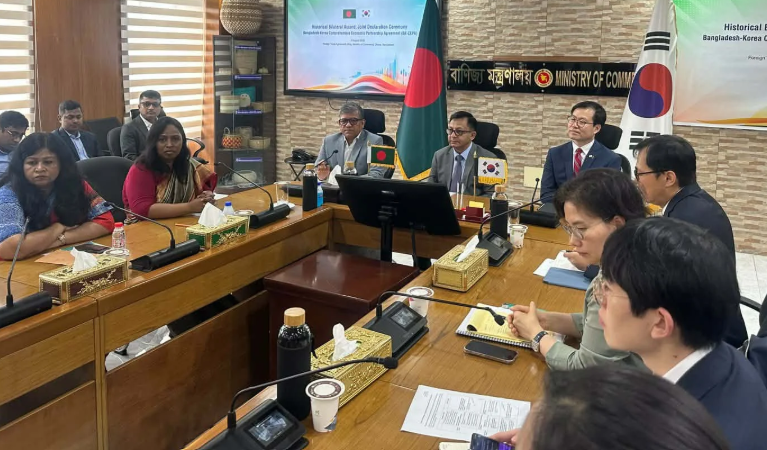
Bangladesh and South Korea on Monday (4 August) signed a landmark Comprehensive Economic Partnership Agreement (CEPA), granting preferential tariff access to the vast majority of goods traded between the two nations in a move officials hailed as a watershed moment for Bangladesh’s trade diplomacy.
Under the agreement, 97 percent of Bangladeshi products will receive preferential tariff treatment in the South Korean market, while 87 percent of South Korean exports to Bangladesh will enjoy similar benefits.
Commerce Minister Khandakar Abdul Muktadir described the deal as a “major milestone” during a press briefing following the conclusion of negotiations at the commerce ministry in Dhaka.
“This is our first comprehensive free trade agreement within five months of taking office,” Muktadir said. “We concluded a trade agreement with one of the world’s largest economies in a very short time.”
The pact marks Bangladesh’s first comprehensive free trade deal under the current government and is expected to significantly reshape bilateral economic relations.
Key Sectors to Benefit
Bangladeshi exports set to gain from the preferential terms include readymade garments, leather goods, and jute products — sectors that form the backbone of the country’s export economy.
On the other side, 87 percent of South Korean exports to Bangladesh, spanning agricultural products, plastics, and spare parts, will enter the Bangladeshi market under reduced tariff arrangements.
South Korean Trade Minister Yeo Han-koo, who joined Muktadir for the signing ceremony, emphasized the five-decade economic relationship between the two countries, which began with the textile sector.
“We need to diversify trade beyond traditional products,” Yeo said, expressing hope that Bangladesh’s new government would further strengthen the economy. He added that Seoul is keen to expand cooperation in technology, supply chains, and investment.
Ambitious Economic Vision
Muktadir framed the agreement within Bangladesh’s broader economic ambitions. “South Korea, with a nearly $2 trillion economy, will become a major trade partner for Bangladesh,” he said.
“We want Bangladesh to become a $1 trillion economy by 2034. To achieve that, we need 8 percent economic growth, which requires more foreign investment. Agreements like this will help attract it,” the minister added.
Current Trade Landscape
Despite the long-standing relationship, bilateral trade between the two countries remains relatively modest. According to Bangladesh’s Ministry of Commerce, total bilateral trade stands at approximately $1.39 billion.
Bangladesh currently exports goods worth $491.73 million to South Korea, while importing $902.9 million, resulting in a trade deficit of roughly $411 million for Dhaka.
Bangladesh’s export basket to South Korea primarily consists of garments, home textiles, leather goods, footwear, pharmaceuticals, jute products, frozen food, and ceramics. South Korean exports to Bangladesh include iron and steel, machinery, electrical goods, plastics, chemicals, and paper products.
Officials on both sides expressed optimism that the CEPA would not only boost trade volumes but also pave the way for deeper economic integration between the two Asian nations.