

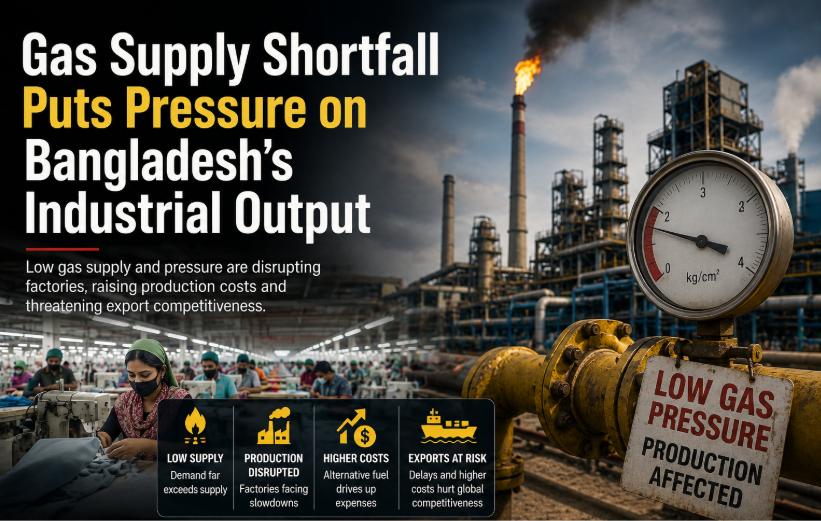
A widening gap between natural gas demand and supply is once again putting pressure on Bangladesh’s industrial sector. Energy-intensive industries are struggling to maintain full production capacity due to low gas pressure, affecting manufacturing costs, supply chains and the timely execution of export orders.
The situation in Gazipur, one of Bangladesh’s largest industrial hubs, illustrates the broader impact of the country’s gas supply constraints. With gas supply falling significantly short of demand, small and medium-sized manufacturing units have been among the hardest hit. Industry leaders warn that a prolonged energy shortage could undermine buyers’ confidence and weaken Bangladesh’s export competitiveness.
Key Numbers
| Indicator | Data |
|---|---|
| Daily gas demand in Gazipur | Around 550 million cubic feet |
| Daily gas supply | Around 300 million cubic feet |
| Estimated shortfall | Around 250 million cubic feet |
| Supply deficit | Approximately 45% |
| Production capacity loss reported by BGMEA (April 2026) | 25–30% |
Production Disruptions in Gazipur
During the first week of August 2026, low gas pressure disrupted production across factories in Gazipur. Combined with weak order volumes and the public and weekend holidays, around 20 percent of factories suspended operations for three to four days.
Industry associations, including BGMEA and BKMEA, said most factories did not shut down completely. Instead, many continued operating at reduced capacity because of insufficient gas pressure.
According to Titas Gas authorities, Gazipur currently requires around 550 million cubic feet of gas per day, while receiving only 300 million cubic feet, leaving a daily deficit of roughly 250 million cubic feet, or about 45 percent of demand.
Factories located in Kaliakair, Sreepur and the Tongi BSCIC industrial areas have been among the most affected.
Industry Concerns
Mohammad Salauddin Chowdhury, chairman of a garment factory in Gazipur, said the prolonged gas shortage is disrupting production and creating uncertainty for future export orders. According to him, if international buyers begin to view Bangladesh’s manufacturing and supply chain as unreliable, they may shift orders to competing countries.
Tapas Pal, manager of PN Composite, also expressed concern that prolonged gas shortages could make it difficult for manufacturers to deliver export orders on schedule, increasing the risk of losing future business.
Low gas pressure also prevents factories from operating boilers and steam systems at full capacity. As a result, processes such as dyeing, washing and finishing slow down, forcing many manufacturers to rely on additional shifts or alternative energy sources, which raises production costs.
Impact on Production Capacity
Bangladesh’s garment manufacturers have previously warned about the consequences of inadequate energy supply.
In April 2026, BGMEA President Mahmud Hasan Khan said inadequate gas and electricity supplies had reduced factory production capacity by 25 to 30 percent, particularly in Gazipur and Ashulia.
While those figures reflected conditions in April, industry observers say the impact varies from factory to factory depending on production processes and energy requirements.
Why Is the Supply Short?
The current situation stems largely from technical problems at one of Bangladesh’s Floating Storage and Regasification Units (FSRU) in late July 2026, which significantly reduced gas injections into the national grid.
The disruption affected industrial users, power generation, commercial establishments and residential consumers alike.
Energy officials expect gas supply to improve gradually after repair work on the LNG terminal is completed. However, manufacturers warn that any prolonged disruption could further affect industrial output and exports.
Why It Matters
Bangladesh’s garment, textile, ceramic, steel, glass and chemical industries rely heavily on natural gas.
Between July and October, garment manufacturers typically produce and prepare export orders for the international Fall/Winter season. From November through January, a significant portion of those products is shipped to overseas buyers.
Any disruption in gas supply during this production cycle can slow manufacturing, increase unit costs and delay export deliveries. Factories often have to depend on diesel generators, alternative fuel sources or additional production shifts, all of which increase operating costs and reduce competitiveness.
A prolonged supply shortage could therefore affect export earnings, foreign exchange inflows, employment and investor confidence.
What Happens Next?
Industry leaders say the immediate priority is restoring normal LNG operations and ensuring a balanced gas distribution system across industrial zones.
Over the longer term, Bangladesh will need greater investment in domestic gas exploration, LNG infrastructure expansion, diversified energy sources and a more resilient energy security strategy to sustain industrial growth.
Btimes Explained
What happens when gas pressure drops?
- Boilers and steam systems cannot operate at full capacity.
- Dyeing, washing and finishing processes slow down.
- Factory productivity declines.
- Manufacturers face higher production costs due to alternative fuel use.
- Export shipments become more difficult to deliver on schedule.
- Small and subcontracting factories are usually affected more than large exporters.
Btimes Insight
The gas shortage in Gazipur is more than a local industrial issue—it reflects a broader challenge facing Bangladesh’s manufacturing economy.
As one of the country’s leading industrial districts, Gazipur provides an important indicator of how energy shortages can affect production, exports and supply chains. If the gap between gas demand and supply persists, the consequences will extend beyond factory floors, influencing export earnings, employment, foreign investment and Bangladesh’s reputation as a reliable global manufacturing destination.
Ensuring a stable and predictable energy supply is therefore not only an operational necessity for factories but also a strategic requirement for maintaining the country’s long-term industrial competitiveness.