

From Ready-Made Garments to Pharmaceuticals—The Industries Powering Bangladesh’s Global Trade
Btimes Trade | August 6, 2026
Exports remain one of the strongest pillars of Bangladesh’s economy. They play a critical role in driving industrialization, creating employment, generating foreign exchange and supporting long-term economic growth.
Today, Bangladesh exports a wide range of products to markets around the world, including ready-made garments, pharmaceuticals, leather goods, agricultural products, home textiles and information technology services.
While the country’s export basket has become more diversified over the years, a handful of industries continue to account for the majority of export earnings.
Bangladesh’s Major Export Sectors
1. Ready-Made Garments (RMG)
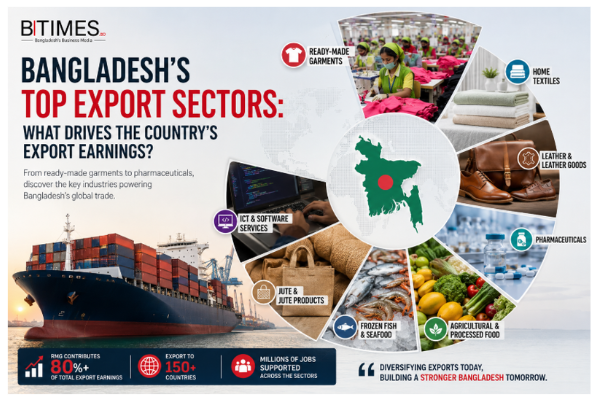
The Ready-Made Garment (RMG) industry is by far Bangladesh’s largest export sector, contributing more than 80 percent of the country’s total export earnings.
Bangladesh is one of the world’s leading apparel exporters, supplying clothing to major markets such as the European Union, the United States, the United Kingdom, Canada and Japan.
The sector also represents one of the country’s largest sources of employment, particularly for women.
2. Home Textiles
Bangladesh has built a strong reputation in home textile products, including towels, bed linens, pillow covers, curtains and other household fabrics.
Growing demand from Europe and North America has helped strengthen the industry’s position in international markets.
3. Leather and Leather Goods
Leather footwear, handbags, wallets, belts and other leather products are among Bangladesh’s most promising export industries.
With higher value addition than many traditional exports, the sector is widely viewed as a key area for future growth.
4. Pharmaceuticals
Bangladesh’s pharmaceutical industry exports medicines to more than 100 countries.
The country’s generic drug manufacturers have gradually expanded their presence in international markets while continuing to meet domestic demand.
5. Agricultural and Processed Food Products
Fresh and processed agricultural products—including fruits, vegetables, tea, spices and processed foods—are gaining increasing recognition overseas.
Demand continues to grow across the Middle East, Europe and parts of Asia.
6. Frozen Fish and Seafood
Frozen shrimp and fish have long been among Bangladesh’s important export products.
The European Union, Japan and the United States remain major destinations for seafood exports.
7. Jute and Jute Products
As global demand for environmentally friendly materials increases, Bangladesh’s jute industry is receiving renewed attention.
Products such as jute bags, carpets, yarn and geotextiles are creating new export opportunities.
8. ICT and Software Services
Although not a physical product, software development, IT outsourcing and digital services are becoming increasingly important sources of foreign exchange earnings.
The country’s growing digital economy is expected to make this sector one of Bangladesh’s future export engines.
Bangladesh’s Key Export Sectors at a Glance
| Sector | Major Products |
|---|---|
| Ready-Made Garments | Knitwear, Woven Apparel |
| Home Textiles | Towels, Bed Linen, Curtains |
| Leather | Footwear, Bags, Belts |
| Pharmaceuticals | Generic Medicines |
| Agriculture | Fruits, Vegetables, Tea, Spices |
| Frozen Foods | Shrimp and Fish |
| Jute | Raw Jute and Jute Products |
| ICT | Software and Digital Services |
Bangladesh’s Major Export Markets
Bangladesh’s exports are primarily destined for:
- European Union (EU)
- United States
- United Kingdom
- Canada
- Japan
- India
- Australia
- Middle Eastern countries
Challenges Ahead
Despite steady progress in export diversification, Bangladesh remains heavily dependent on the garment industry.
Global economic slowdowns, energy shortages, rising production costs, supply chain disruptions and changing international trade policies could significantly affect export performance.
Economists believe that expanding higher-value industries—including pharmaceuticals, engineering products, processed foods, leather goods, ICT services and home textiles—will be essential for building a more resilient export economy.
Btimes Insight
Bangladesh’s export success has been built largely on the Ready-Made Garment industry. However, long-term sustainable growth will depend on reducing dependence on a single sector.
Diversifying exports, investing in higher-value manufacturing, expanding technology-driven industries and entering new international markets will be key to strengthening Bangladesh’s position in the global economy.
Editor’s Note: This is an evergreen reference feature. Export values, market shares and sectoral contributions may change over time as new trade data become available. The article will be updated periodically to reflect the latest official statistics.